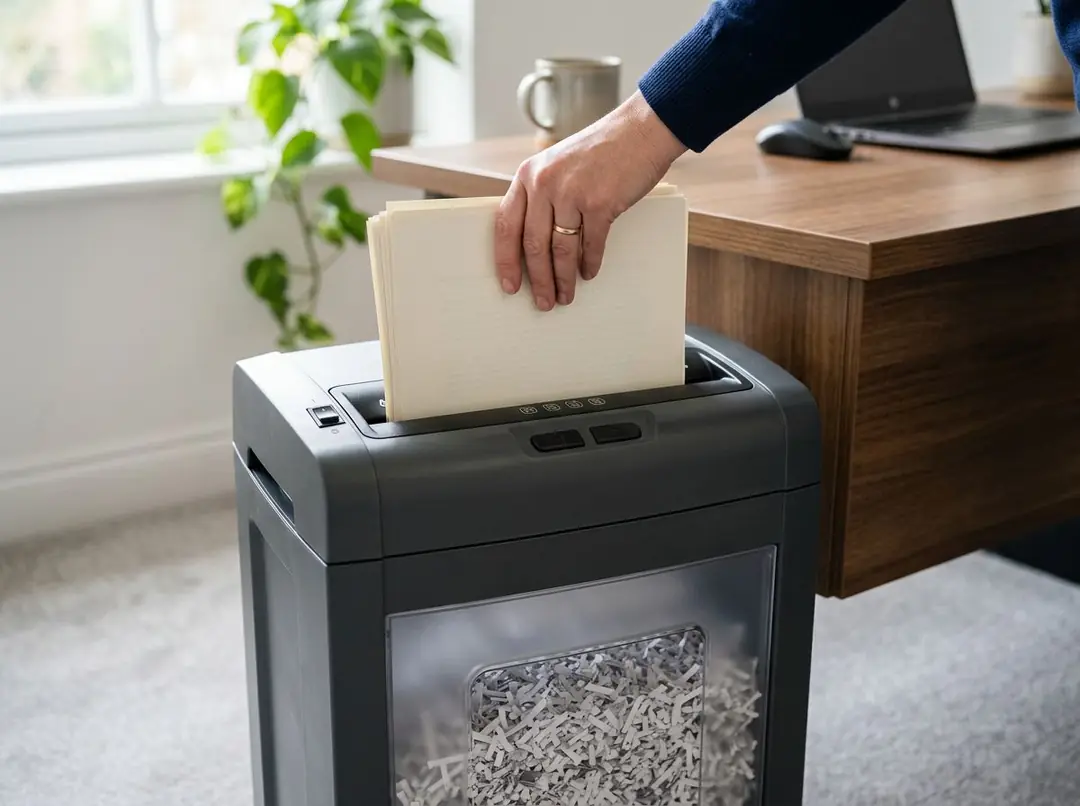



Sheet capacity is the number on the front of the box, and on its own it tells you remarkably little. A machine rated for 12 sheets that runs for three minutes is a worse purchase for a busy office than one rated for eight sheets that runs for thirty.
Sizing a shredder well means looking at four numbers together, and starting from how the office actually works rather than from the specification sheet.
Start with users, not sheets
Manufacturers rate machines by intended user count, and it is a far more useful starting point than raw capacity because it bundles several engineering decisions into one figure.
- Personal (1 user). A deskside machine for someone shredding a handful of pages a day. Compact, relatively quiet, small bin, short duty cycle. Perfectly adequate for its purpose and badly out of its depth beyond it.
- Shared (2 to 5 users). A small team machine. Longer duty cycle, larger bin, and jam protection genuinely matters because several people with different habits will use it.
- Departmental (5 to 10+). A floor machine. Run time measured in tens of minutes, bin sized so emptying is a weekly rather than daily job, and a chassis built to be used constantly.
- Commercial. Continuous operation, often auto-feed, high capacity. Bought where shredding is a scheduled task rather than an interruption.
If you are between categories, size up. The cost difference is usually smaller than the cost of a machine that frustrates people into not using it.
The four numbers that matter
Sheet capacity
Pages per pass, measured with fresh 20lb paper. Treat it as a ceiling rather than a target. Feeding consistently at two-thirds of the rating roughly doubles the practical life of the cutting head and largely eliminates jams. Remember that stapled, folded, glossy or humid paper all count for more than one sheet.
Continuous run time
How long the motor runs under load before thermal protection forces a stop. This is the specification most often ignored and most often regretted.
It is a hard stop, not a warning, and recovery typically takes 20 to 40 minutes. A machine with a three-minute run time and a thirty-minute cool-down delivers only a few minutes of shredding per hour in practice. For a desk that is irrelevant; for a department it is the whole ballgame.
Bin capacity
In gallons, and it determines how often somebody does the least popular job in the office. A 5-gallon bin on a shared machine is a daily task. A 20-gallon bin under the same load is weekly.
Two adjustments: finer cuts fill bins faster for the same weight of paper, and a bin emptied only when completely full backs paper up into the cutting head, which causes jams from below.
Security level
Covered in detail in our guide to DIN levels, but it belongs in the sizing conversation because it trades directly against the other three. Higher security means smaller particles, which means lower sheet capacity and faster bin fill for the same machine size and price.
Auto-feed changes the calculation
An auto-feed machine takes a stack — often 100 to 600 sheets — and works through it unattended while you do something else.
If your shredding happens in batches rather than page by page, auto-feed is usually the deciding feature, and it can justify choosing a machine with lower manual sheet capacity. The relevant number becomes the auto-feed tray capacity rather than sheets per pass, and total time matters less because nobody is standing there.
A worked example
An office of six people clearing roughly 200 pages a week, mostly invoices and correspondence with occasional HR paperwork.
A personal machine would be emptied constantly and spend much of its time cooling. Technically capable, practically miserable.
A micro-cut departmental machine at P-5 would handle it securely but with a smaller bin and more frequent emptying than the material warrants — most of that paper does not need P-5.
The right answer is a shared or departmental cross-cut machine at DIN P-4, run time above 15 minutes, bin of at least 7 gallons. If the HR paperwork is genuinely sensitive and regular, add a small micro-cut unit for that alone rather than upgrading the whole machine.
Two mistakes worth avoiding
Sizing for the peak rather than the pattern. An annual archive clear-out is not a reason to buy a commercial machine for daily use. Hire a service for the clear-out and size the purchase for the other 51 weeks.
Sizing for the most sensitive document. If 2% of your paper needs P-5 and 98% needs P-4, buying one P-5 machine for everything means everyone waits for the 98%.
Checking a specific machine
Every shredder product page on this site lists sheet capacity, maximum run time, bin capacity in gallons, DIN level and recommended number of users in the specification table. Read all five before deciding — a machine is only as good as its weakest relevant number.
Browse by intended use: personal and home, small office, or commercial and departmental shredders.