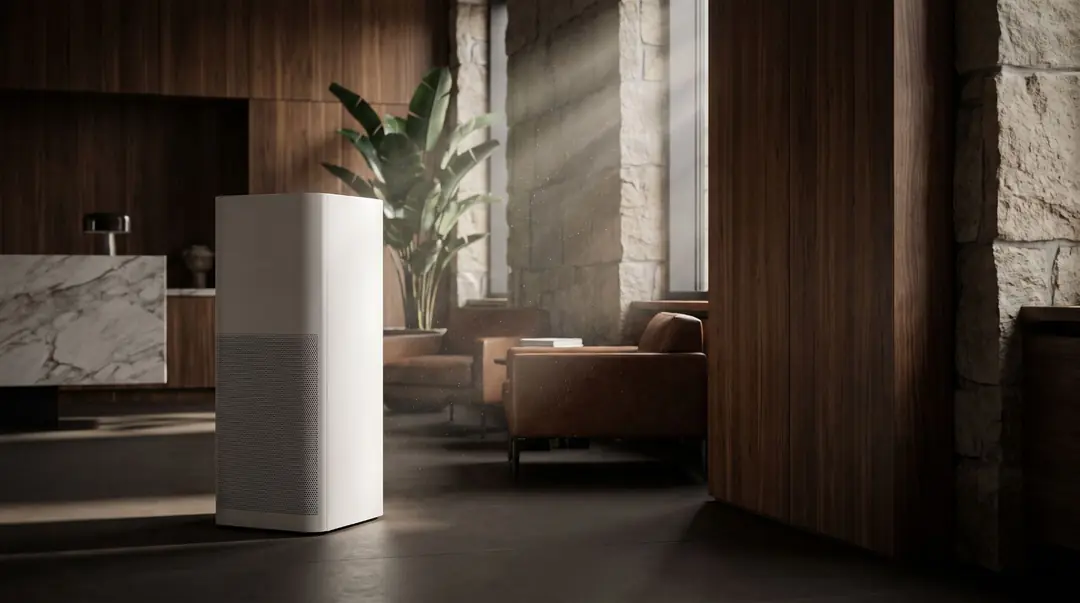
Air purifiers are rated by the room size they can handle, and that single specification decides whether the unit does its job. An undersized purifier runs constantly and never quite catches up; an oversized one costs more than it needed to but at least works.
Getting it right means understanding what the room-size figure actually assumes.
Room size ratings and air changes
Manufacturers state a maximum room area in square feet. That figure assumes a standard ceiling height and, critically, a specific number of air changes per hour — how many times the unit can process the room's entire volume in sixty minutes.
A purifier rated for 400 square feet might deliver five air changes per hour in a 200 square foot room, but only two or three in the full 400. Both are technically "within rating"; they perform very differently.
Useful targets:
- Two to three air changes — general background filtration in a low-traffic space.
- Four to five — a sensible target for offices and shared rooms.
- Five or more — where air quality genuinely matters: clinic waiting rooms, allergy-prone occupants, spaces with known pollutant sources.
In practice, aiming higher means buying a unit rated for a larger room than you actually have. Sizing for roughly double your floor area is a reliable rule when air quality is the point rather than a nice-to-have.
Work from volume, not floor area
A conference room with a 12-foot ceiling holds half again the air of the same floor plan at 8 feet. Room-size ratings assume standard height, so high ceilings quietly reduce the air-change rate you actually get.
If your ceilings are above standard, size up. Open-plan spaces and rooms that open into corridors should be treated as larger than their nominal footprint too, since air moves freely between them.
What the filter stages do
Pre-filter. Captures dust, hair and large particles. Its real job is protecting the expensive filter behind it, and it is often washable — cleaning it on schedule extends the life of everything downstream.
True HEPA. Captures 99.97% of particles at 0.3 microns, which is the hardest particle size to catch. This is the stage that deals with allergens, dust, pollen and airborne particulates, and it is the specification to insist on.
Be careful with wording. "HEPA-type", "HEPA-like" and "99% HEPA" are not True HEPA. If the specification does not state True HEPA with the 99.97% at 0.3 micron figure, treat it as a lesser filter and price it accordingly.
Activated carbon. Adsorbs odours, gases and volatile organic compounds. This is a completely separate function from HEPA, which does nothing at all for smells. If odour is part of the problem — a kitchen area, a print room, new furniture off-gassing — you need carbon specifically, and ideally a decent amount of it rather than a thin impregnated layer.
Some units add UV-C or ionisation stages. Treat these as supplementary; the HEPA and carbon stages do the measurable work.
Placement changes performance more than people expect
A purifier needs air moving around it. Pushed into a corner, tucked behind a filing cabinet or set under a desk, it recirculates the same small pocket of air and the room-size rating becomes meaningless.
- Give it clearance on the intake side — typically a foot or more.
- Keep it out of the direct path of a doorway draught, which pulls unfiltered air straight through.
- Position it where people actually are, not in an unused corner.
- For larger open spaces, two smaller units usually outperform one large one placed centrally, because they cover two circulation zones instead of one.
Noise, and why it decides whether the unit gets used
Purifiers are rated at maximum fan speed, and maximum is usually loud enough to be distracting in an office. The practical consequence is that people turn them down, and a unit running on low delivers a fraction of its rated air changes.
The workaround is to size up and run slower: a larger unit on a low setting is quieter and moves more air than a smaller unit on high. Check whether the specification lists decibel figures per speed setting rather than a single headline number.
Plan for filter replacement before you buy
Filters are a running cost, not an afterthought. True HEPA filters typically need replacing every 6 to 12 months depending on use; carbon filters more often in high-odour environments; pre-filters are usually washable.
Check replacement filter price and availability before committing to a model. Over three years, filter costs frequently exceed the purchase price of the unit, and that total is where the real comparison between two models lies.
Filter-change indicators help, but they usually run on elapsed hours rather than actual loading — treat them as a reminder rather than a measurement.
Commercial and wall-mounted units
For waiting rooms, classrooms, corridors and reception areas, wall-mounted or hardwired units solve problems floor-standing models create: they cannot be knocked over, unplugged, or shuffled into a corner. They also tend to deliver higher air-change rates for the same footprint, and they keep floor space clear.
The trade-off is installation, and the fact that placement is then fixed — so it is worth thinking through circulation before mounting anything.
Browse commercial air purifiers, SOHO units for smaller spaces, and replacement filters and accessories.