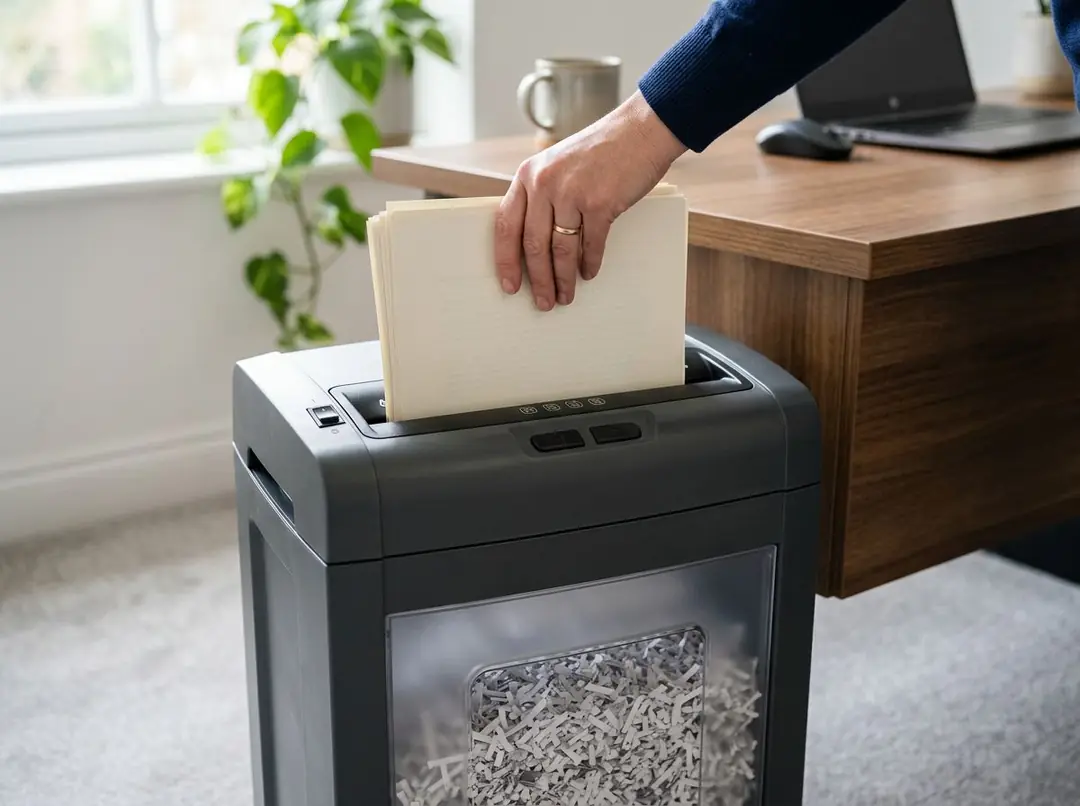


Every shredder sold in the US carries a DIN 66399 security rating, running from P-1 to P-7. Most buyers never look at it. The result is predictable: some offices destroy junk mail with machines built for classified material, and others put customer records through a shredder that produces strips you could reassemble on a kitchen table.
The rating is not complicated once you know what the number measures.
What the number actually measures
DIN 66399 defines the maximum particle size a machine may produce. A lower number means larger pieces and an easier reconstruction job; a higher number means more pieces per sheet and a correspondingly harder one. The standard covers several media types, but the "P" series is the one that matters for paper.
- P-1 — strips up to 12mm wide, or particles up to 2,000mm². General, non-sensitive material only.
- P-2 — strips up to 6mm, or particles up to 800mm². Still strip-cut territory.
- P-3 — particles up to 320mm². The first level generally considered adequate for documents carrying a name or address.
- P-4 — particles up to 160mm². The practical business default, and the level most commercial cross-cut machines target.
- P-5 — particles up to 30mm². Specified where material is confidential rather than merely private.
- P-6 — particles up to 10mm². Rare outside regulated environments.
- P-7 — particles up to 5mm². Written for classified government material. One sheet becomes several thousand fragments.
Choosing the right level for your documents
The honest answer for the large majority of offices is P-4. It covers customer records, invoices, payroll summaries, correspondence and internal reports, and it does so without the throughput penalty finer cuts bring. If you buy one machine for a mixed office and do not want to think about it further, P-4 cross-cut is the correct default.
P-2 is genuinely sufficient for offices shredding only junk mail, old catalogues, superseded drafts and internal notices. Choosing P-2 for that material is not cutting corners — it is matching the tool to the job, and you will empty the bin far less often.
Step up to P-5 when reconstruction would cause real harm: medical records, client financial files, HR case documents, anything covered by a contractual confidentiality obligation. The step from P-4 to P-5 is a genuine increase in protection, not a marketing tier.
P-6 and P-7 are worth paying for only when a regulation, contract or security policy names them. The cost in speed and bin capacity at these levels is significant, and paying it without a requirement behind it buys you inconvenience rather than safety.
What the standard does not tell you
A DIN level describes particle size and nothing else. It says nothing about how many sheets the machine takes per pass, how long it runs before overheating, how loud it is, or whether it will survive a stapled document. Two machines can share a P-4 rating and be completely different purchases.
This matters because security level and practical usability pull against each other. A P-4 machine might take 12 sheets per pass and run 20 minutes before a cool-down. A comparably priced P-5 machine typically takes fewer sheets and fills its bin noticeably faster, because the same sheet of paper is now several thousand particles rather than several hundred, and loose particles occupy more volume than flat strips.
The failure mode of over-buying is not wasted money so much as wasted time: a machine people queue behind, and a bin someone empties every afternoon.
Regulatory context, briefly
US regulations covering document destruction — HIPAA for health information, FACTA for consumer report data, GLBA for financial institutions — generally require that information be rendered unreadable and unreconstructable. They do not, as a rule, name a DIN level.
That leaves the choice to you, which is why P-4 has become the de facto business standard and P-5 the common answer for regulated records. If you operate under a specific contractual or sector requirement, check whether it names a level before deciding; where it does, that requirement overrides any general advice.
How to check a machine before buying
Every shredder product page on this site lists the DIN level and the cut size in inches in its specification table, alongside sheet capacity, run time and bin volume. Read those together. A useful habit when comparing two machines:
- Confirm the DIN level covers your most sensitive document type.
- Check sheet capacity against how you actually feed paper — most people overfeed.
- Check continuous run time against how long a typical shredding session lasts.
- Check bin capacity, remembering that finer cuts fill bins faster.
If a machine passes all four, the DIN level on the box is doing its job rather than decorating it.
A note on mixed requirements
Offices that handle both routine paperwork and a small volume of sensitive documents often assume they need one high-security machine. Two machines are frequently the better answer: a fast P-2 or P-4 unit for volume, and a smaller P-5 or higher unit for the confidential minority. The combined cost is often lower than a single high-security machine sized for the whole load, and throughput is better.
Browse by security level with our high security shredders (DIN P-5 and P-7), or start from cut type with cross-cut, micro-cut and strip-cut machines.