


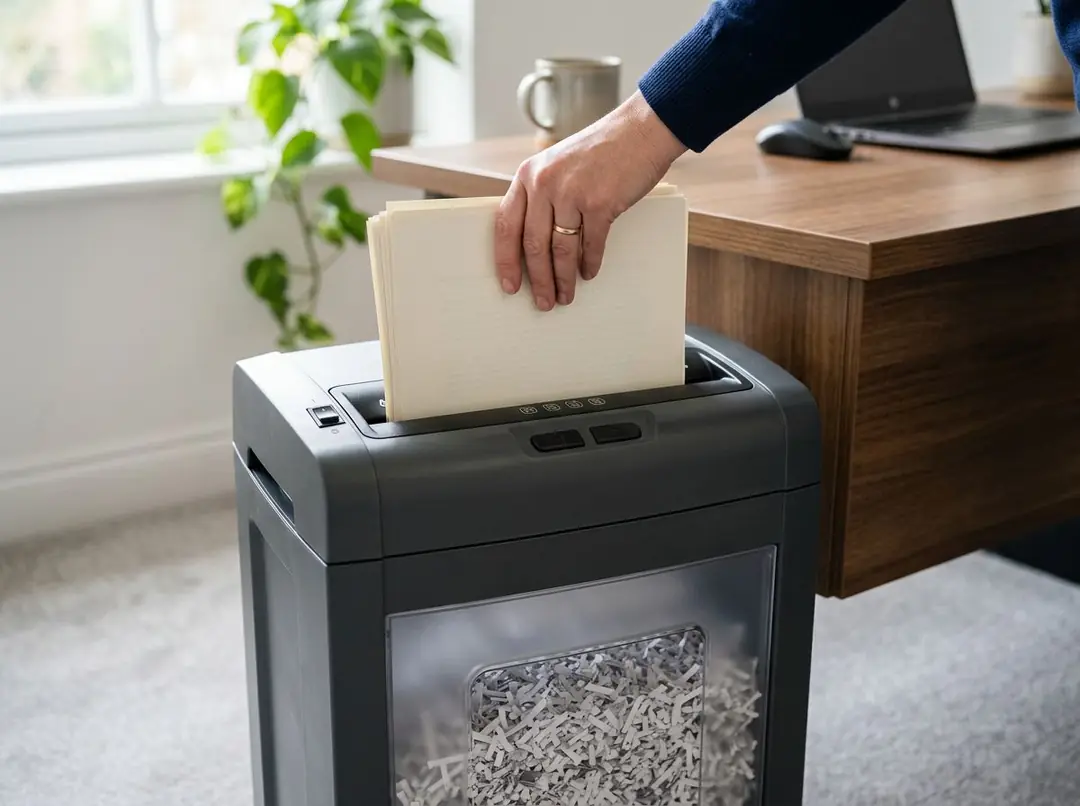
Oiling is the highest-return maintenance task on a shredder and the one most often skipped. Dry cutters work harder, jam more often, run hotter and wear out years early. A substantial share of shredder failures and warranty claims trace back to nothing more complicated than missed lubrication.
It takes about a minute.
Why it matters more than it sounds
A shredder cutting head is two sets of hardened blades meshing at close tolerance. Paper is abrasive, and it carries dust, clay fillers and coating residue that accumulate on the blades.
As that residue builds, friction increases. Higher friction means the motor draws more current to turn the same cutters, and the extra current becomes heat. Heat is what triggers the thermal cut-out — so a dry machine reaches its duty-cycle limit sooner than its rating suggests. The same friction dulls the blades, and dull blades tear paper rather than cutting it cleanly, which is what produces jams.
The chain is short and entirely preventable: no oil → friction → heat and dulling → jams, shorter run time, early failure.
How often
The practical rule: oil every time you empty the bin. It scales naturally with use and attaches the task to something already happening. A busy departmental machine gets oiled weekly; a personal deskside unit perhaps monthly.
If you prefer a volume-based rule, most manufacturers suggest oiling every time you have shredded a few hundred sheets. Machines with an auto-oiling reservoir handle this themselves — top it up when the indicator asks and otherwise leave it alone.
Cross-cut and micro-cut machines need it most. Their cutting heads have far more blade surface in contact with paper, so residue accumulates faster. Strip-cut machines are more forgiving but still benefit.
The method
- Empty the waste bin first. Oiling a full bin just soaks the shreds and wastes the oil.
- Apply across the full width of the entry slot. A steady zig-zag from one end to the other. Covering only the centre is the most common mistake — the outer cutters do work too, and they are the ones that dull first if neglected.
- Run in reverse for 10 to 15 seconds. This distributes oil across the whole cutting head rather than leaving it sitting on the top edge of the blades.
- Shred two or three sheets of scrap. This spreads the oil evenly and picks up any excess that would otherwise drip into the bin.
That is the whole procedure. If the machine sounds noticeably quieter afterwards, it needed it.
What not to use — this matters
- Never aerosol or spray lubricants. The propellants are flammable, and a shredder generates both heat and paper dust. Sprays also leave a residue that attracts more dust than it displaces.
- Never vegetable or cooking oil. It oxidises. Over weeks it polymerises into a sticky varnish on the blades that is worse than no lubricant at all and difficult to remove.
- Avoid general-purpose machine oil unless the manufacturer names it. Shredder oil is formulated specifically not to combine with paper dust into a paste.
- Do not over-apply. More is not better. Excess oil runs into the bin, soaks the shredded paper and can interfere with paper recycling.
Using the wrong lubricant can void the cutter warranty — worth noting because the cutter warranty is usually the longest part of the cover, often five years or more against one year on the machine itself.
Bottled oil or lubricant sheets?
Bottled oil is cheaper per application and lets you deliberately cover the full slot width. It suits machines with one regular user who will do the job properly.
Lubricant sheets are pre-oiled sheets you simply shred. They are cleaner, faster and effectively impossible to get wrong, which makes them well suited to shared machines where nobody wants to handle a bottle. They cost more per application and distribute slightly less thoroughly.
Both work. The one that actually gets used regularly is the right one — a bottle in a drawer that nobody opens is worse than sheets sitting on top of the machine.
Signs you have left it too long
- The machine is noticeably louder, or its pitch has changed under load.
- It jams on sheet counts it used to handle comfortably.
- It reaches its thermal cut-out well before its rated run time.
- Shredded output looks torn or fibrous at the edges rather than cleanly cut.
All four are reversible if caught early. Oil thoroughly, run a few scrap sheets, and repeat after the next bin change. If the symptoms persist after two or three proper oilings, the cutters are likely worn — check the cutter warranty before replacing the machine.
Auto-oiling machines
Some larger machines carry an oil reservoir and lubricate themselves on a cycle. They remove the discipline problem entirely, which on a shared departmental machine is worth a great deal — the failure mode of manual oiling is not difficulty, it is that nobody owns the task.
Two things still need attention. The reservoir needs topping up when the indicator asks, and the oil type is usually specified by the manufacturer rather than generic. Running an auto-oiler dry is worse than a manual machine, because everyone assumes it is being handled.
A maintenance schedule you can keep
Most shredder maintenance advice fails because it asks people to remember something on a calendar. Attaching each task to an event that already happens works better:
- Every bin change: oil the cutters across the full slot width.
- Monthly, or when it sounds different: check the vents are clear and the machine has clearance behind it.
- Quarterly on shared machines: lift the head and look at the underside of the cutters for accumulated residue or a lodged clip.
- Annually: check the warranty status, particularly the cutter warranty, so you know where you stand before something fails.
Keeping the oil beside the machine rather than in a supply cupboard does more for compliance than any reminder system.
Stock up on shredder oil and lubricant sheets, and check your bin size against our shredder waste bags so emptying and oiling become one routine.