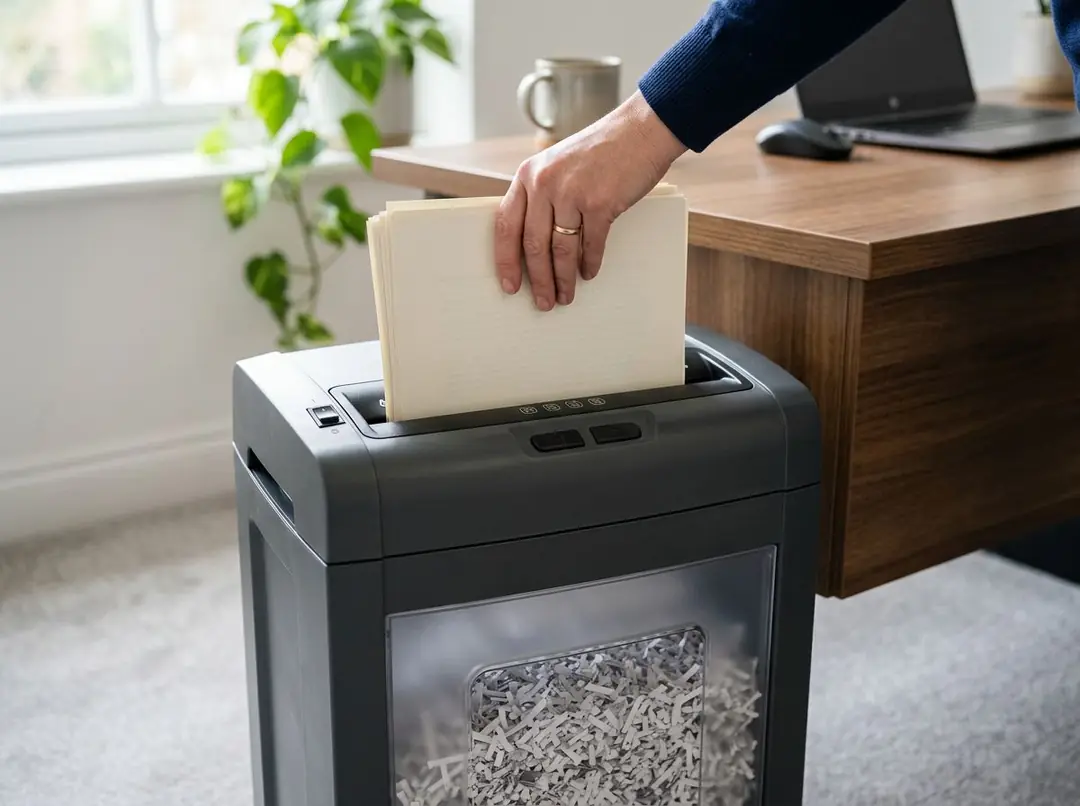



Cut type is the first thing printed on a shredder box and the least explained. It determines how secure the output is, how fast the machine works, how often you empty the bin and how loud the whole business is. The right answer depends entirely on what you are feeding it.
Strip-cut
Strip-cut machines pass paper through a single set of rotating blades, slicing it into long vertical ribbons. One sheet becomes roughly 30 to 40 strips running the full length of the page.
Advantages. Strip-cut is the fastest and highest-capacity option at any given price. The cutting head does less work per sheet, so machines take more pages per pass and run longer before overheating. Bins hold far more paper because flat strips settle into compact layers rather than filling space loosely. Maintenance demands are lower too.
The limitation. Long strips retain whole lines of text, and reconstruction is genuinely feasible. Strip-cut typically rates DIN P-1 or P-2.
Use it for bulk destruction of material carrying nothing personal: superseded drafts, old catalogues, internal notices, marketing overruns. For that work it is not a compromise — it is the right tool, and a micro-cut machine would be slower and more expensive for no benefit.
Cross-cut
Cross-cut machines use two sets of blades turning against each other, cutting in both directions at once. A single sheet becomes several hundred short particles rather than a few dozen strips.
Why it is the default. The security jump from strip to cross is large, and the cost in throughput is modest. Most cross-cut machines rate DIN P-3 or P-4, and P-4 is broadly accepted as appropriate for personal data. If you are buying one shredder for a mixed office, this is the category to shop in.
The trade-offs. Bins fill faster than strip-cut because particles pack less efficiently. Sheet capacity is usually a little lower for a machine of similar size and price. Cross-cut machines also need oiling more regularly, because the cutting head has far more surface in contact with paper.
Micro-cut
Micro-cut is cross-cut taken considerably further, reducing a sheet to thousands of confetti-sized particles. Ratings typically start at DIN P-4 and run to P-5 and beyond.
When it is worth it. Where the paper carries financial, legal, medical or HR information, or where a contract or policy requires it. The output is genuinely difficult to reconstruct by any practical means.
What it costs you. Two things people underestimate. Bins fill markedly faster — the same ream of paper becomes many times more loose particles, and loose particles do not settle. And sheet capacity is lower for comparable machines, because the cutting head is doing far more work per pass. A micro-cut machine rated for 8 sheets is doing more work than a cross-cut machine rated for 14.
A decision rule that holds up
Rather than comparing specifications, ask what is actually on the paper:
- No names, no numbers, nothing personal? Strip-cut. It will be faster and cheaper to run, and you are not giving anything up.
- Customer or employee data — names, addresses, account references? Cross-cut at P-4. This covers the overwhelming majority of business paperwork.
- Would reconstruction cause financial, legal or reputational harm? Micro-cut at P-5 or above.
- Does a regulation or contract name a level? That requirement settles it, whatever this guide says.
The mistake worth avoiding
The common error is buying entirely for the most sensitive document an office handles, when that document is 2% of the volume. A single micro-cut machine sized for the whole load means everybody waits and somebody empties the bin daily.
Where volumes are mixed, two machines frequently work out better and cheaper: a fast cross-cut or strip-cut unit for everyday paper, and a smaller micro-cut unit for the confidential minority. Throughput improves and total cost often falls.
What else to compare once cut type is settled
Cut type narrows the field; three other numbers decide between what remains.
Sheet capacity is measured with fresh 20lb paper. Stapled sets, folded pages, glossy stock and humid paper all count for more than one sheet. Treat the published figure as a ceiling, not a target.
Continuous run time is how long the motor runs before thermal protection forces a cool-down — typically 20 to 40 minutes of recovery. A machine with the right cut type but a three-minute duty cycle will frustrate everyone using it.
Bin capacity in gallons determines how often someone does the least popular job in the office. Remember that finer cuts fill bins faster for the same weight of paper.
Noise, in brief
Cut type affects sound. Strip-cut machines are generally quietest; micro-cut machines work hardest and are usually loudest. For a shredder sitting beside a desk or in a quiet shared office this is worth weighing, and some models publish a decibel figure or carry noise-reduction features in their specification.
Browse by cut type: cross-cut, micro-cut, or strip-cut shredders. If security level is your starting point instead, see high security shredders.